Band topology and quantum geometry in moiré flat bands
Flat bands, characterized by nearly zero dispersion and vanishing group velocity, suppress electronic kinetic energy and amplify interaction effects—often giving rise to correlated phases. Beyond the energetics, the quantum geometry of these bands has also been shown to play a central role in shaping low-energy correlations (Yu et al., 2025). A prominent setting for realizing such bands is in moiré systems, where stacking 2D materials with a small twist angle or lattice mismatch produces long-wavelength interference patterns that yield isolated flat bands. Notable examples include twisted bilayer graphene (Bistritzer and MacDonald, 2011) and twisted bilayer transition metal dichalcogenide (Devakul et al., 2021) near the magic angle, which have led to the observation of superconductivity (Yankowitz et al., 2019) and fractional Chern insulators (Park et al., 2023). These moiré-induced flat bands offer a tunable platform to explore strongly correlated and topological phenomena.
An alternative route to realizing flat bands lies in lattice geometry itself, where destructive interference or local constraints can suppress the dispersion in certain geometrically frustrated lattices—such as kagome lattice (Syozi, 1951). A particularly illustrative class involves bipartite lattices with an imbalance numbers between sublattice sites, where flat bands emerge due to such an imbalance (Calugaru et al., 2022). Notable examples include Lieb (Lieb, 1989) and dice (Sutherland, 1986) lattices. These systems exhibit geometry-induced flat bands that are robustly tied to the underlying lattice geometry, and they provide a complementary platform to moiré materials for exploring flat band physics.
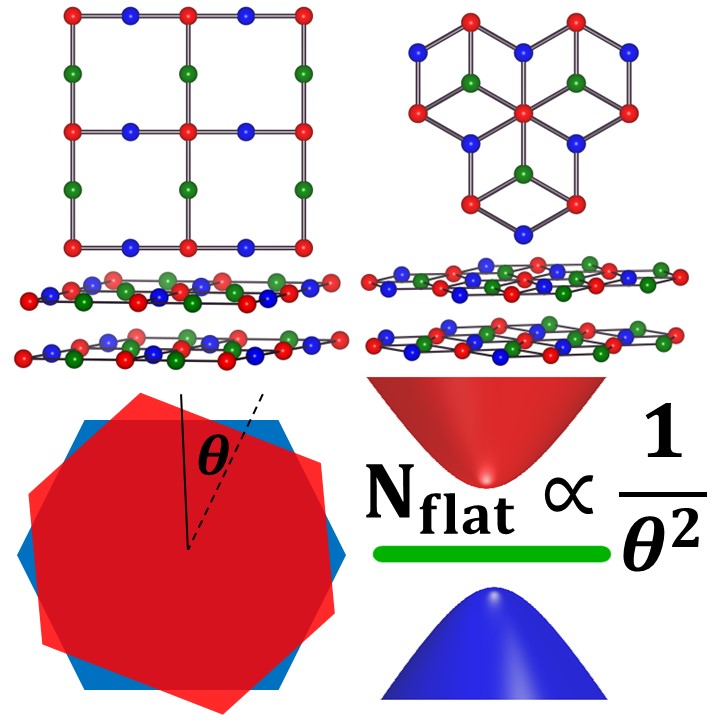
It is then natural to ask: what new physics might emerge when these two flat-band-generating mechanisms—moiré engineering and lattice geometry—are combined in a single system. Surprisingly, our study shows that the geometry-induced flat bands in their twisted homobilayer become isolated due to the moiré potential, where the numbers of isolated flat bands vary with twist angle [1]—a new physics that has never been found in popular twisted bilayer systems. Furthermore, in their twisted heterobilayers, the Berry curvature of such flat bands are also twist-angle tunable [2]. In addition to bipartite lattices, we proposed a newly discovered lattice structure—the watermill lattice—whose geometry hosts low-energy high-pseudospin fermions. In its twisted bilayer form, these states give rise to four isolated flat bands with enhanced quantum geometry [3]. More recently, in twisted bilayers of loop-current-ordered kagome lattices, we demonstrated that the quantum geometry of moiré flat bands can be fundamentally reconfigured and need not inherit that of the parent monolayer [4], revealing a mechanism distinct from those established in systems such as TBG and TMD moiré materials. These results serve as compelling examples of how lattice geometry and moiré engineering can work in tandem to realize and control flat-band electronic structures.
Related Publications
[1] Xiaoting Zhou*, Yi-Chun Hung*, Baokai Wang*, and Arun Bansil. Generation of isolated flat bands with tunable numbers through moiré engineering. Phys. Rev. Lett. 133, 236401 (2024; Editors’ Suggestion).
[2] Xiaoting Zhou*, Yi-Chun Hung*, and Arun Bansil. Quantum Geometry of Moir´e Flat Bands: A Bipartite Lattice Paradigm Beyond Valley Physics. arXiv:2603.20852.
[3] Yi-Chun Hung*, Xiaoting Zhou*, and Arun Bansil. Geometry-driven moiré in twisted bilayers of high pseudospin fermions. Phys. Rev. B 112, L041403 (2025).
[4] Yi-Chun Hung, Xiaoting Zhou, and Arun Bansil. Breakdown of Topological Inheritance and Twist-Induced Quantum Geometry Reconfiguration in Moiré Flat Bands. arXiv:2603.20849.