
Helical Luttinger liquid (HLL) in double quantum spin Hall insulators (DQSHIs) and helical domain-wall-ring network
Helical edge states are 1D conducting channels where electron with different spin move in opposite directions. These states usually emerge at the edges of Quantum Spin Hall Insulators (QSHIs) (Kane and Mele, 2005). Their helical nature forbids elastic backscattering in the absence of time-reversal symmetry (TRS) breaking, resulting in robust spin-polarized transport along the edge. However, in 1D systems, electron–electron interactions are inevitable and often play a crucial role in determining the low-energy physics (Giamarchi, 2004). The helical nature prohibits backscattering but allows only forward scattering, making the system an ideal platform for realizing a helical Luttinger liquid (HLL) (Wu et al., 2006). In this interacting regime, the edge states exhibit collective behavior and non-Fermi liquid characteristics, such as power-law scaling of correlation functions and interaction-dependent transport properties (Hsu et al., 2021). The helical Luttinger liquid thus provides a natural theoretical framework to capture the interplay between topology and strong correlations in one-dimensional edge systems.
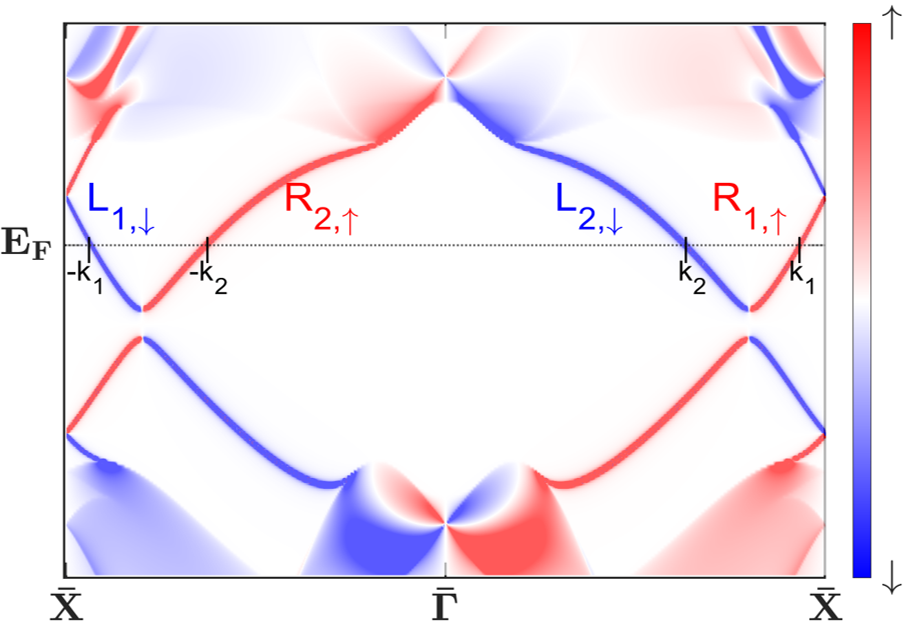
Double Quantum Spin Hall Insulators (DQSHIs) extend the QSHI concept by supporting two independent helical edge channels, often arising from systems with high spin Chern or mirror Chern numbers [1][2]. Such a high spin (mirror) Chern number indicates that the edge Dirac cones are not protected by TRS and can be open due to spin-U(1) symmetry breaking perturbations. Also, the coexistence of multiple helical edge modes introduces the possibility of inter-channel forward scattering. These properties indicate that low-energy states in DQSHIs can be gapped without breaking TRS or the presence of Umklapp scattering—a sharp contrast to QSHIs. This leads to a higher-order topological insulator phase [3][4], as well as correlated phases supporting Majorana Kramers pairs [5] and competing π-superconductivity and π-spin density wave [6].
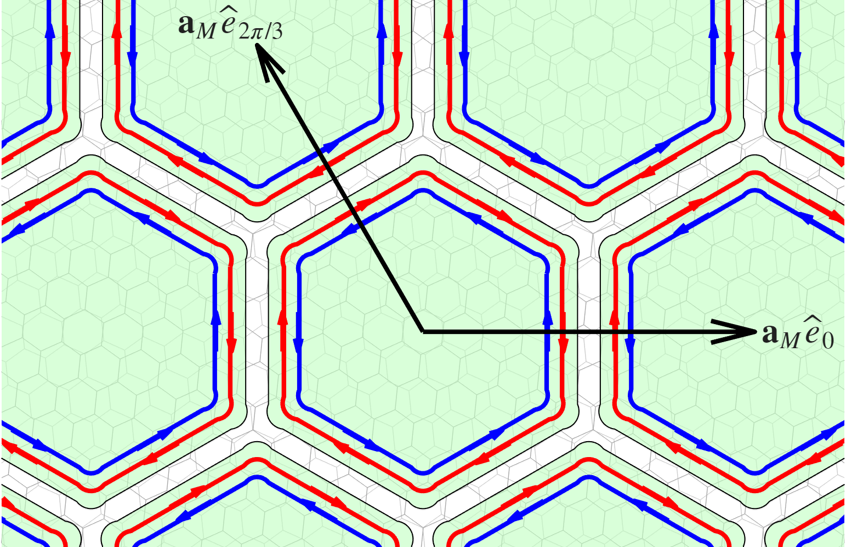
Beyond QSHI and DQSHIsm 1D helical states can also emerge at the domain-walls of a moiré pattern (Bordoloi et al., 2026), forming helical domain-wall-ring network. In helical domain-wall-ring networks formed in twisted bilayer honeycomb systems, we found that superconducting correlations are qualitatively reshaped by the interplay of ring confinement and interactions [7]: As the twist angle decreases, the pair-tunneling-induced mass is strongly suppressed by phase-different fluctuations while the sueprconducting scaling dimension remain decreasing. Instead of simply approaching the infinite-size limit at small twist angle, where the pair tunneling is RG relevant and induces significant mass term, these networks exhibit a distinct fluctuation regime controlled by their ring-network geometry.
Related Publications
- [1] Yueh-Ting Yao, Xiaoting Zhou, Yi-Chun Hung, Hsin Lin, Arun Bansil, and Tay-Rong Chang. Feature-energy duality of topological boundary states in a multilayer quantum spin Hall insulator. Phys. Rev. B 109, 155143 (2024).
- [2] Baokai Wang, Xiaoting Zhou, Yi-Chun Hung, Yen-Chuan Lin, Hsin Lin, and Arun Bansil. High spin-chern-number insulator in α-antimonene with a hidden topological phase. 2D Materials 11 025033 (2024).
- [3] Baokai Wang, Yi-Chun Hung, Xiaoting Zhou, Arun Bansil, and Hsin Lin. Higher-order topological phases hidden in quantum spin Hall insulators. Phys. Rev. B 108, 245103 (2023).
- [4] Yi-Chun Hung, Baokai Wang, Chen-Hsuan Hsu, Arun Bansil, and Hsin Lin. Time-reversal soliton pairs in even spin Chern number higher-order topological insulators. Phys. Rev. B 110, 035125 (2024).
- [5] Yi-Chun Hung, Chen-Hsuan Hsu, and Arun Bansil. Majorana Kramers pairs in synthetic high-spin Chern insulators. Phys. Rev. B 111, 245145 (2025).
- [6] Yi-Chun Hung, Chen-Hsuan Hsu, and Arun Bansil. Tunable Competing Electronic Orders in Double Quantum Spin Hall Superlattices. Phys. Rev. B 112, 195127 (2025).
- [7] Yi-Chun Hung and Arun Bansil. Helical Domain-Wall-Ring Networks Reshape Superconducting Correlations. arXiv:2606.23599.